Home / Pharma News / Record high drug shortages in the US
Record high drug shortages in the US Posted 17/06/2011
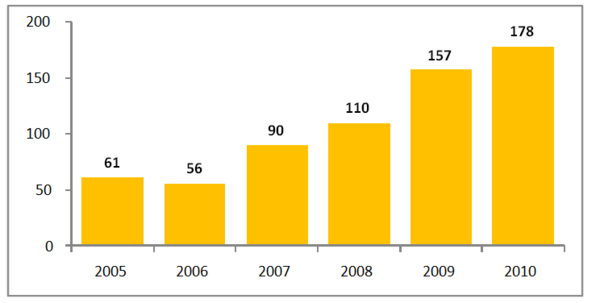
In 2010, there were 178 drugs that experienced shortages in the US, see Figure 1. This is a record high level and regulators blame quality and manufacturing problems for the crisis. Worse still, many of the drugs identified in 2010 remain unavailable or in short supply in 2011.
Figure 1: Drug shortages in the US between 2005-2010 Source: FDA The number of drug shortages reported to the FDA has reached critical levels, almost tripling in the last six years and affecting all areas of healthcare. In 2010, 178 drug shortages were reported, 74% of which involved sterile injectable drugs. The shortages affected cancer drugs, anaesthetics and IV electrolytes, as well as drugs needed for emergency medicine. This problem does not only affect originator medicines. According to a report by Premier healthcare alliance, more than 400 generic equivalents were also backordered for more than five days. A major reason for these shortages has been quality/manufacturing issues. However, there have been other reasons such as production delays at the manufacturer, delays due to receiving raw materials and components from suppliers, as well as discontinuations. The shortages have also been exacerbated by a number of reasons including stockpiling by end users and ‘gray market distributors’ – where distributors buy up available supplies and offer to sell them on at hugely inflated prices. The FDA has continued to see an increasing number of shortages in 2011, especially those involving older sterile injectable drugs. Many companies are discontinuing production of these older drugs as they are not as profitable as other newer drugs. The problem is also that firms are not obliged to warn the FDA about any impending problems with supply of drugs. When the agency is made aware of a supply problem, it works with other firms who manufacturer the drug, asking them to ramp up production, if possible, in order to prevent or mitigate a shortage. Generics have a definite beneficial role to play here. Maintaining supply of older injectable drugs and ramping up production when manufacturing problems arise elsewhere are just some of the ways generics can help to prevent such shortages occurring. Related articles
Source: FDA, Premier healthcare alliance
Comments (0)
Generics News Research General
- Clopidogrel goes off-patent: last of the old-st...Generics/General | Posted 18/05/2012
- Generic atorvastatin could save NHS GBP 350 mil...Generics/News | Posted 18/05/2012
- Can generic competition succeed at reducing cos...Generics/Research | Posted 11/05/2012
- Also noted on generics: 11 May 2012Generics/General | Posted 11/05/2012
Biosimilars News Research General
- Biosimilar filgrastim provides cost savings for...Biosimilars/Research | Posted 11/05/2012
- US Supreme Court looks set to challenge Afforda...Biosimilars/General | Posted 18/05/2012
- Biosimilars approved and marketed in BelgiumBiosimilars/General | Posted 18/05/2012
- Daiichi Sankyo and Coherus BioSciences make bio...Biosimilars/News | Posted 18/05/2012